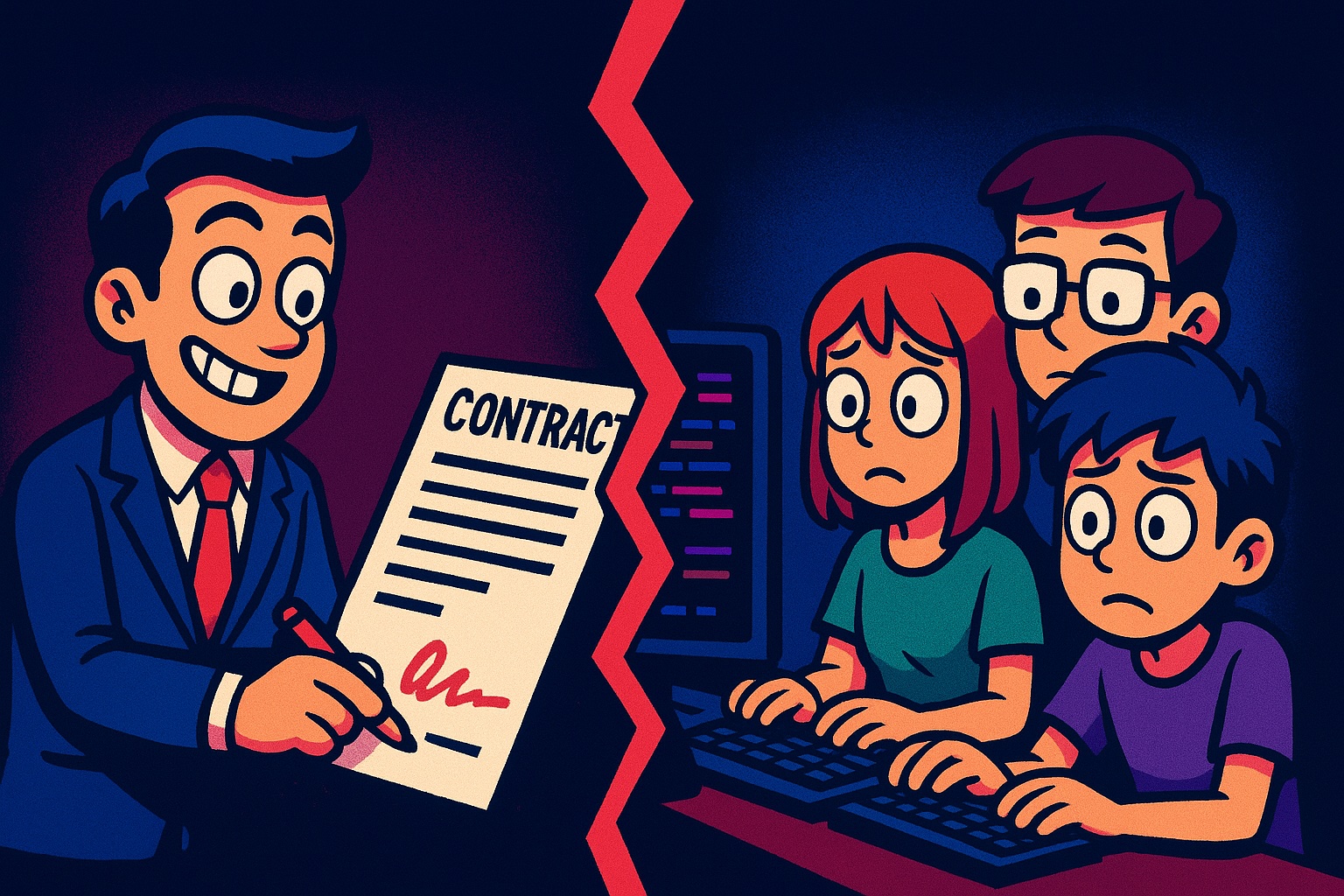
Your Sales Team Is Writing Cheques Your Dev Team Can't Cash

The frequency that I hear "what security obligations?" or "what data processing requirements?" from CTOs is astounding, particularly for companies that are business-to-business (B2B) or serving European and Canadian markets. This leads me to think that technical leaders in these organizations are not prepared for a very large and very public compliance gap in their businesses.

When your sales team closes a new deal, they're not just agreeing to deliver your existing product. Increasingly, enterprise contracts include data processing agreements (DPAs), standard contractual clauses for EU and UK clients, and specific security obligations that translate directly into development requirements. These aren't just legal formalities—they're binding commitments that often require significant engineering work to fulfill.

The problem? Most development teams never see these contracts.

The Development Disconnect

I often see that contractual obligations are implemented without consultation with the development office, and the results can be damaging with costly backpedals on implementation. It's frequently found that security controls promised in contracts such as data deletion capabilities or specific encryption standards must be built retroactively, overstepping budgets and timelines or collecting far more development resources than anticipated.

By considering compliance implications during the design and implementation of features, companies can better safeguard themselves from unauthorized liability, contractual breaches, and regulatory penalties. A combined approach ensures that promised features are not only delivered, but also architected appropriately, reducing the risk of technical debt, user mistrust, and reputational damage.

Your sales team gets the signature, celebrates the win, and moves on to the next prospect. Meanwhile, the technical obligations sit buried in legal documents that never make it to your sprint planning sessions or product roadmap. Months or even years later, when an audit occurs or new legislation triggers compliance reviews, you might discover you've been in breach of contract the entire time.

The Cost of Reactive Development

Consider the implications: a client realizes you haven't implemented the data deletion capabilities promised in your DPA, or a regulatory body finds that industry-specific security measures outlined in your contract were never actually built. The resulting legal exposure, potential fines, and damage to customer relationships can be devastating.

While investing in compliance features may seem daunting, particularly when they're discovered as emergencies, addressing them proactively can lead to various efficiencies. By consolidating contractual requirements into your development roadmap, companies can often reap the benefits of tools, training, and processes that serve multifunctional needs, avoiding a waste of resources and streamlining development processes.

Consider architecture but also training when it comes to pooling development efforts. Often a singular compliance framework can be implemented that suits multiple client requirements, instead of building bespoke solutions for each contract. Training, particularly in development compliance, can overlap across many client needs, and combining multiple contractual obligations into a single development sprint avoids developer fatigue and addresses multiple concerns efficiently.

Building the Bridge Between Sales and Development

Similarly, holistically addressing policies and procedures can prevent duplication of effort across contracts. Privacy and security requirements, when considered at the same time as feature development, can ensure that the right team members are engaged up front, avoiding costly rework and having to double back later. This is particularly true in sensitive implementations like data retention policies and incident response capabilities.

The solution requires a fundamental process change that brings development into the contracting conversation. This doesn't mean developers need to negotiate deals, but it does mean creating systematic communication channels between your customer-facing teams and technical teams.

I'm seeing increasing overlap between contractual frameworks and technical requirements, which is great progress for development planning! If you're implementing SOC2 compliance for one client, you can opt for additional Trust Service Principles which will address requirements for multiple clients; many of which would stand you in great stead with strict contractual obligations. Similarly, if you're building GDPR compliance features for European clients, you can extend these capabilities to address similar privacy requirements for other jurisdictions.

The Strategic Advantage in Contractual Compliance

In today's competitive landscape, companies that proactively address contractual obligations gain a significant edge. Demonstrating a commitment to fulfilling technical commitments sets businesses apart from their competitors and positions them as trustworthy partners in the eyes of enterprise clients. This competitive advantage can translate into faster deal closures and sustainable growth over time.

I recommend starting by establishing a contract review process that flags any technical obligations before deals are signed. Create a standardized checklist that identifies data processing requirements, security commitments, industry-specific compliance measures, and any custom development promises made during the sales process.

Your legal and sales teams should be trained to recognize when contract language creates development work. Terms like "upon request," "within 30 days," or "in accordance with GDPR" often translate into specific feature requirements that need engineering resources.

Make contractual obligations a formal input to your software development lifecycle. When I work with development teams on onboarding new clients, I always recommend reviewing their specific contract requirements alongside technical integration needs. Include compliance features in your sprint planning and product roadmaps with the same rigor you apply to customer-requested enhancements.

Organizations that get this right turn compliance from a cost center into a competitive advantage. When your product natively supports the security and privacy requirements that enterprises demand, your sales team can close deals faster and command premium pricing. When competitors scramble to retrofit compliance features, you're already compliant and can focus on innovation.

Taking Action

If all of this sounds wildly complicated and is something you've never contemplated, I'm here to help you develop your contract review processes and handle your updates to your development planning. Don't let the gap between what your sales team promises and what your development team delivers become the hidden risk in plain sight.

The key is recognizing that in today's regulatory environment, every contract your company signs likely includes technical obligations. Make sure your development team knows what they are.

If you'd like to explore these challenges further with your team, I'd be happy to come speak with your development and leadership teams about practical strategies for bridging this critical gap. These conversations often provide immediate value through real-world examples and the opportunity to address your specific questions and concerns.

Feel free to reach out to me to discuss bringing me in to speak with your team. Let's transform contractual obligations from hidden risks into strategic opportunities together!

Previous
Previous

Privacy Debt: The Hidden Iceberg Ahead